
Mixed-element dogs, seasons and life stages: using the Five Elements wisely, with your vet
Few dogs are pure Wood, Fire, Earth, Metal or Water. To close our series: how to read a blended dog, how seasons and age shift things, a simple self-check, and how to bring it all to your vet without replacing them.

If you have read the whole series, you may have found your dog in two or three places at once. The bold walker who drags you to the park gate sounds Wood, the way they flop on cold tiles in April sounds Fire, and the begging at the dinner table is pure Earth. That is not a sign you are doing it wrong. It is how the framework is meant to work.
This post closes our Five Elements series. Catch up with the beginner's guide and the five types: Wood, Fire, Earth, Metal and Water, plus our guide to warming and cooling foods.
One honest reminder: the Five Elements are a traditional Chinese veterinary medicine (TCVM) way of observing temperament and tendencies. They are not a diagnosis, the scientific evidence is limited, and anything that looks like a health problem goes to your vet.
Your dog sounds Wood on walks, Fire in April and pure Earth at dinner. That is how the framework works.
Most dogs are a blend
In the tradition, every dog carries all five elements, with one or two more prominent. Practitioners often talk about a main element and a supporting one. Some common blends you may recognise:
- Wood and Fire: confident and sociable, quick to excite, needs plenty of exercise and clear boundaries. Many young Labradors fit here.
- Earth and Metal: calm, food-loving and routine-bound. Easy to live with, but watch the waistline and the stool when routines change.
- Fire and Water: friendly with people they know but easily rattled by noise. Often the dog who greets guests happily and then hides at the first cracker.
- Wood and Water: confident at home, wary outside. Can look reactive on walks when the real feeling is worry.
Indies are a good reminder that blends are normal. A dog who survived the streets of Bangalore may be bold about food (Earth), watchful of strangers (Water) and fiercely protective of their gate (Wood), all at once.

How seasons shift things
Each element has its season in the tradition, and dogs are said to show more of an element, and its weak spots, during that season. Bangalore's climate does not follow the Chinese calendar neatly, but here is a loose fit:
- Wood, spring (roughly February to March): restlessness, more pulling and reactivity, itchy eyes.
- Fire, summer (April to May): overheating, excitability, restless nights.
- Earth, late summer and damp (the monsoon months): sluggish digestion, loose stools, weight creeping up.
- Metal, autumn (October to November): dry skin, sneezing, Diwali smoke, sensitivity to routine changes.
- Water, winter (December to January): feeling the cold, stiff joints, more fear and clinginess.
Note what changes in your dog across the year. Seasonal patterns are useful to share with your vet whatever framework you use.
How age shifts things
Life stage moves dogs around too. Puppies and adolescents often show a lot of Wood and Fire energy: bold, busy, excitable. Many settle into a more Earth-like middle age, content and food-focused. In the tradition, ageing is linked to Water, so older dogs often become more cautious, feel the cold and need more care for joints, kidneys and hearing. Big life events, such as adoption, a house move, a new baby or the loss of a companion, can also bring out a different side.
So your answer at two years old may not be your answer at ten. Revisit it.
Your answer at two years old may not be your answer at ten.
A simple self-check
There is no scoring here, because a number would suggest a precision the framework does not have. Instead, take a notebook and spend a week observing.
- Five words. Describe your dog on an ordinary good day.
- Under stress. When something goes wrong, does your dog push forward, get over-excited, look for food or comfort, withdraw, or hide?
- Where the body complains. Eyes and tendons, heart rate and heat, tummy and weight, skin and breathing, or ears, joints and bladder?
- Best and worst seasons. When is your dog at their best, and when do problems show up?
- Match and rank. Compare your notes with the table below and pick the two elements that fit best.
Treat the result as a conversation starter, not a label.
How to talk to your vet about it
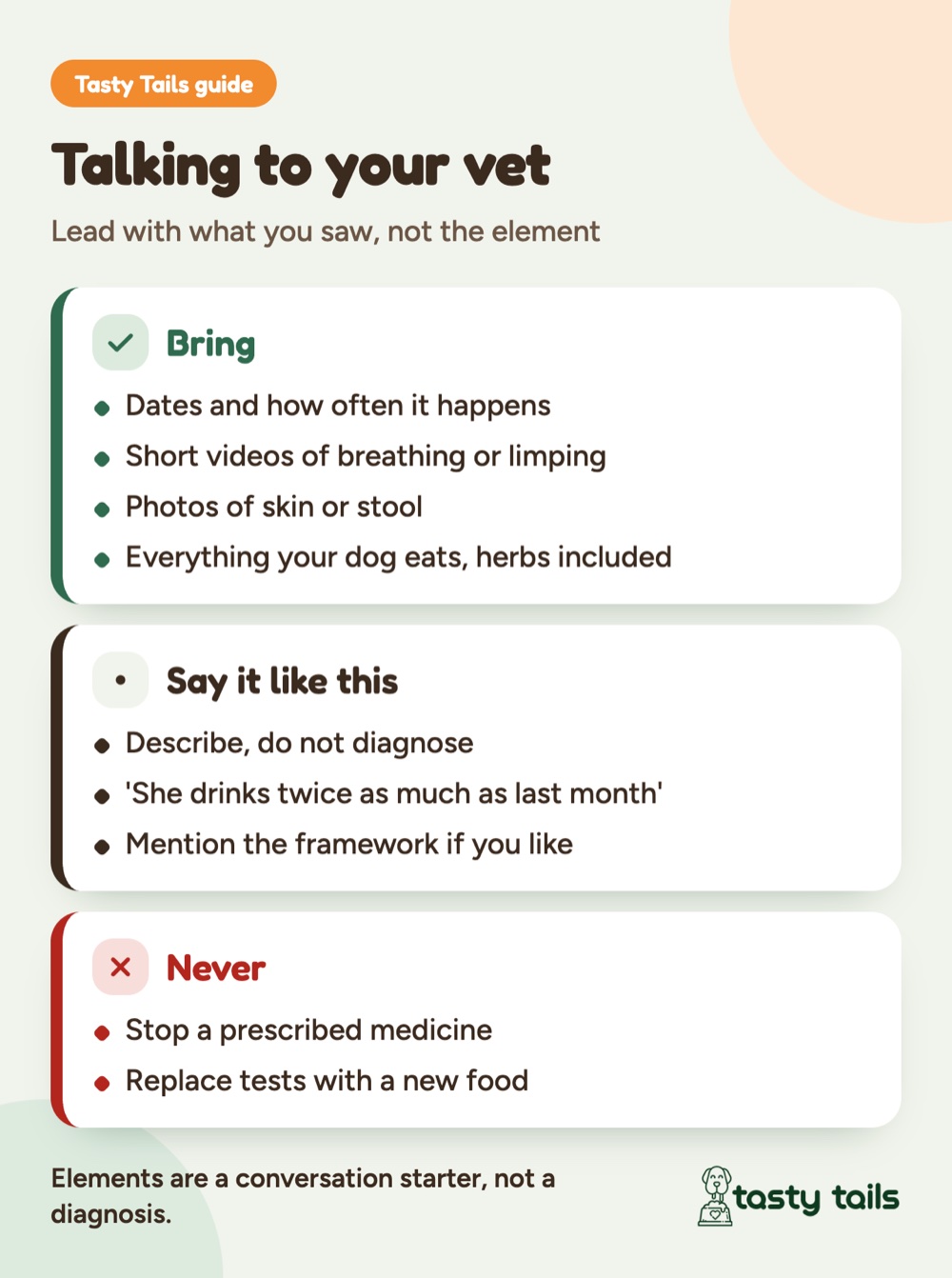
Your notebook is valuable to any vet, conventional or integrative, as long as you lead with what you saw rather than with the element.
- Describe, do not diagnose. "She drinks about twice as much as last month" is far more useful than "her Water is weak".
- Bring evidence: dates, how often, short videos of odd breathing, limping or behaviour, and photos of skin or stool.
- Mention the framework if you like. Many vets are happy to hear "I have been reading about TCVM and wondered if her cold-seeking matters".
- List everything your dog eats, including treats, toppers, herbs and supplements. Herbal products can interact with medicines.
- Never stop a prescribed medicine because of something you read about elements.
Looking for a TCVM-trained or integrative vet
Some vets add training in acupuncture, herbal medicine or food therapy to their conventional degree. Organisations such as Chi University and the International Veterinary Acupuncture Society (IVAS) train and certify vets in these methods. Such vets are still few in India, so ask your regular clinic first. A good integrative vet:
- Is a registered veterinarian, with registration under the Veterinary Council of India or your state council.
- Examines your dog and runs conventional tests where needed before suggesting anything traditional.
- Explains what the evidence does and does not show.
- Works alongside your regular vet rather than asking you to choose.
The limits of the framework
- Evidence is limited. Research on TCVM ranges from promising (some work on acupuncture for pain) to thin. The element types themselves have not been tested as a way of predicting illness.
- It cannot diagnose. A "Water" dog drinking more needs blood and urine tests, not a new food, and a "withdrawn Metal" dog may simply be in pain. Our guide to subtle signs of pain helps.
- It can become a story we tell ourselves. Once we have decided a dog is Fire, we tend to notice only the Fire. Keep observing.
- Behaviour problems need real help. Serious fear or aggression calls for a vet and a qualified, reward-based trainer or behaviourist.
Go to the vet now, whatever your dog's element, for trouble breathing, collapse, pale or blue gums, a swollen tight belly with retching, straining to pee with nothing coming out, seizures, or a suspected poisoning. For poisonings, call your nearest 24-hour vet; the ASPCA Animal Poison Control Center can also advise.
From our kitchen
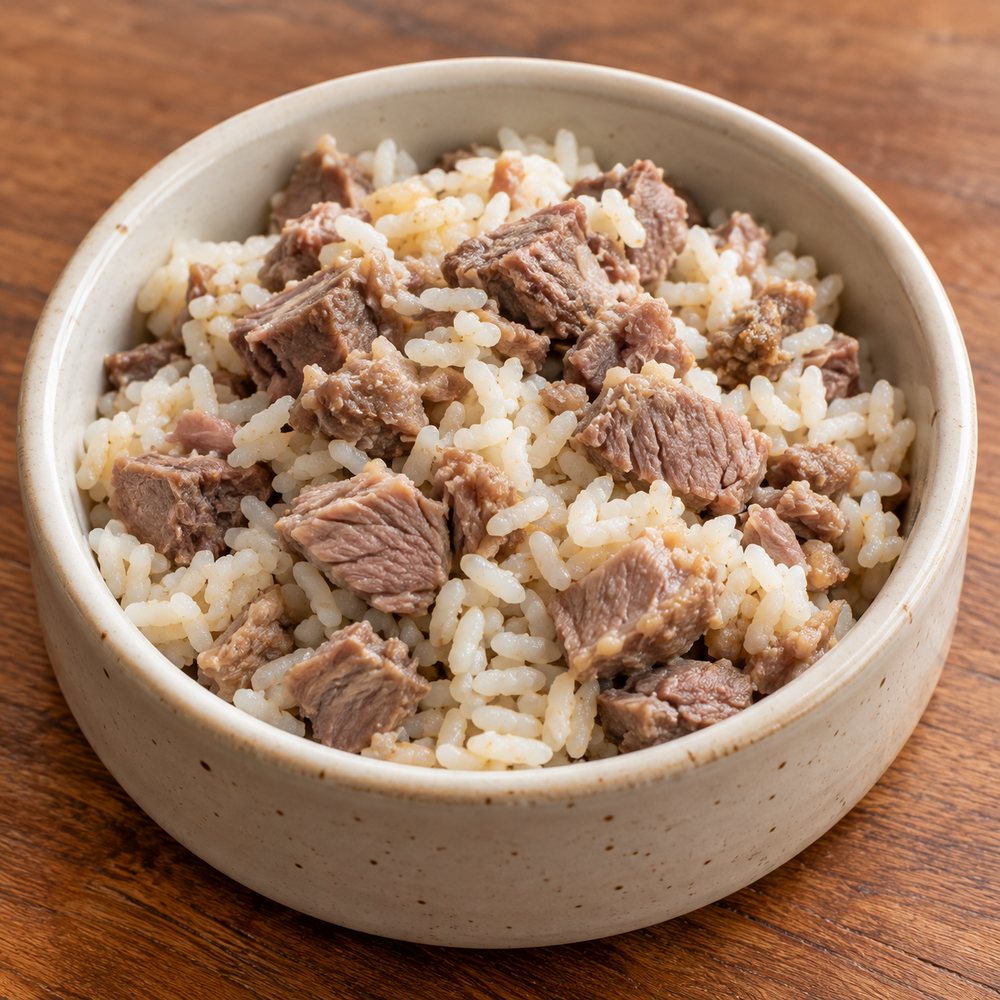
Whatever the blend, the base diet should be complete, balanced and easy to adjust. Tummy Full combines chicken, pumpkin, carrots, beans, broccoli and rice as a dependable everyday bowl. The Fish & veggie bowl, gently boiled fish with steamed green beans and carrots, is a lighter option for warm months. Mutton Nom Nom, just mutton and rice, is a simple warming change for cool December evenings.
Questions about mixed-element dogs
Can my dog's element change?
The tradition says a dog's core nature stays fairly constant, but which element shows most can shift with seasons, age and life events. Revisit your notes every year or so.
Is there a proper test for my dog's element?
No validated test exists. Questionnaires in books are guides for observation, and a TCVM-trained vet will look at the whole dog rather than a score.
Do I need a TCVM vet to use the Five Elements?
No. You can use the framework to observe your dog and share notes with any vet. A TCVM-trained vet is worth seeking if you want acupuncture or food therapy alongside conventional care.
Can I use the elements to choose a puppy?
Only loosely. Puppies change a lot as they grow, so meet the parents, watch the puppy in different situations and talk to the breeder or shelter about temperament.
Sources
- AVMA: Complementary, alternative and integrative veterinary medicine policy
- Chi University (TCVM training for veterinarians)
- International Veterinary Acupuncture Society (IVAS)
- Cheryl Schwartz, Four Paws, Five Directions: A Guide to Chinese Medicine for Cats and Dogs (Celestial Arts)
- Elizabeth Anne Johnson, Know Your Dog's True Nature
- ASPCA Animal Poison Control
Everyday bowls for every element
A balanced chicken-and-veg staple, a light fish bowl and a simple mutton bowl, so you can rotate gently through the seasons.

Main Meals For dogs & cats
Tummy Full
-

-

-

-

-

- +4
- Protein
- Healthy fats
- Fibre
- Vitamins
₹350 Small · 250 g 4 sizes

Main Meals For dogs & cats
Fish & veggie bowl
-
-

-
-

-

- +2
- Protein
- Healthy fats
- Fibre
- Vitamins
₹495 Small · 250 g
Main Meals For dogs & cats
Mutton Nom Nom

- Protein
- Healthy fats
- Vitamins
- Slow-release energy
₹525 Medium · 350 g
See the full menu or ask our nutritionist what suits your pet.
Was this helpful?
Share with a pet parent