How much should my dog eat? A simple calorie guide
The formula vets use to estimate how many calories your dog needs, how to turn that into grams of food, and how to tell if the portion is right.
The feeding chart on a pack is a starting point, written for an "average" dog who may be nothing like yours. An energetic young Indie who runs in the park every evening and a neutered Labrador who naps through a Bangalore afternoon can weigh the same and need very different amounts of food. Here is how vets estimate it, in three steps.
Step 1: Resting energy
Vets start with the resting energy requirement (RER), the calories your dog would burn lying still in a comfortable room:
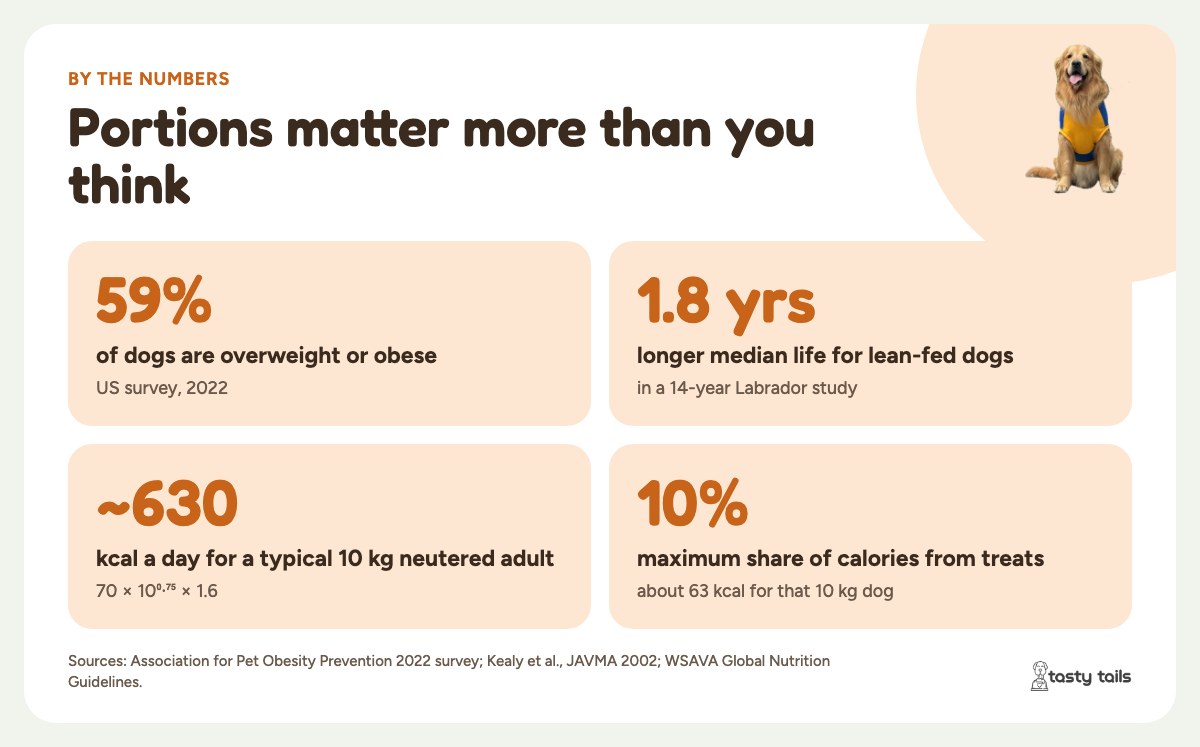
RER = 70 × (body weight in kg)^0.75
You don't need to do the maths by hand. Rough values:
- 5 kg: about 234 kcal a day
- 10 kg: about 394 kcal a day
- 20 kg: about 662 kcal a day
- 30 kg: about 898 kcal a day
Notice that a 30 kg dog needs less than four times what a 5 kg dog needs, even though it weighs six times as much. Bigger bodies are more efficient, which is why the formula uses a power of 0.75 instead of simply multiplying by weight.
Step 2: Multiply for life stage and activity
Next, multiply the RER by a factor that matches your dog. These are the common starting points from veterinary guidelines:
- Neutered adult, normal activity: 1.6
- Adult that isn't neutered: 1.8
- Less active, or gains weight easily: 1.2 to 1.4
- Very active or working: 2 or more
- Puppy up to 4 months: 3.0
- Puppy from 4 months to adult size: 2.0
- Weight loss: 1.0, using the target weight (plan this with your vet)
A worked example
Bruno is a 10 kg neutered adult Indie with normal activity. His RER is about 394 kcal, and 394 × 1.6 gives roughly 630 kcal a day. If his food has 150 kcal in 100 g, that is 630 ÷ 150 × 100 = 420 g a day, or two meals of about 210 g.
Our nutrition guide has a calculator that does this for you.
Step 3: Watch the dog, not the number
Any formula can be off by 20 to 30% for an individual dog, because of genes, coat, temperament and how much they really move. So treat the number as a first guess and check it against your dog's body.
Feed the dog in front of you, not the number on the pack.
The body condition check
- Ribs: you should feel them easily with light pressure, under a thin layer of fat, without seeing them.
- From above: a visible waist behind the ribs.
- From the side: the belly tucks up between the ribs and the hind legs.
Vets score this on a 9-point scale, where 4 to 5 is ideal. Each point above 5 is roughly 10% extra body weight.
Adjusting the portion
- Weigh your dog every two to four weeks at first, at the same time of day.
- If they are gaining and shouldn't be, cut the daily amount by about 10% and check again in a few weeks. Do the opposite if they are losing.
- Change one thing at a time, so you know what worked.
Don't forget treats and "just a bite"
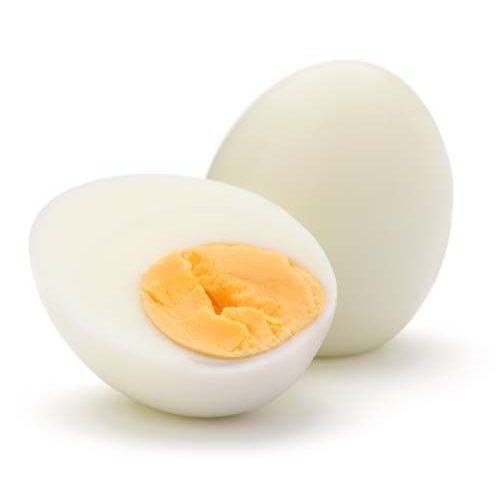
Treats, chews and table scraps should make up no more than 10% of daily calories. For Bruno that is about 63 kcal: roughly one boiled egg, or a few small pieces of plain chicken. A whole chapati can be 70 to 100 kcal, which is a lot of a small dog's day. If treats go up, the meal portion should come down. Our guide to healthy homemade treats has ideas that fit the budget.
Breeds that need a closer eye
Labradors and Golden Retrievers, both popular in Indian cities, are famously food-motivated. Research in Labradors found that many carry a gene variant (in POMC) linked to greater hunger and lower energy use, so they can gain weight on portions that keep other dogs lean. Beagles, Pugs and Cocker Spaniels also tend to put on weight easily. Indies are often lean and active, but neutered, apartment-living Indies can gain weight too.
Every Tasty Tails product page lists estimated calories per 100 g, so you can turn your dog's number into grams. Tell us your dog's weight and routine and we'll suggest portions.
Questions pet parents ask
How many times a day should I feed my dog?
Most adult dogs do well on two meals a day. Puppies need three or four smaller meals, and some seniors and small breeds are happier with three.
How do I know if my dog is overweight?
You should be able to feel your dog's ribs easily under a thin layer of fat, see a waist from above, and see the tummy tuck up from the side. If you can't, talk to your vet about a target weight.
Should I follow the feeding guide on the packet?
Use it as a starting point only. Guides are averages and are often generous. Weigh your dog every two to four weeks and adjust the portion by about 10% at a time.
Sources
- WSAVA Global Nutrition Guidelines, including the body condition score charts
- National Research Council (2006): Nutrient Requirements of Dogs and Cats
- AAHA 2021 Nutrition and Weight Management Guidelines
- FEDIAF Nutritional Guidelines for complete and complementary pet food
- Raffan E. et al. (2016). A deletion in the canine POMC gene is associated with weight and appetite in obesity-prone Labrador Retriever dogs. Cell Metabolism 23(5): 893–900.
Portion-friendly meals and treats
Lean proteins and light soups that are easy to portion. Share your dog’s weight and we’ll work out how much to serve.



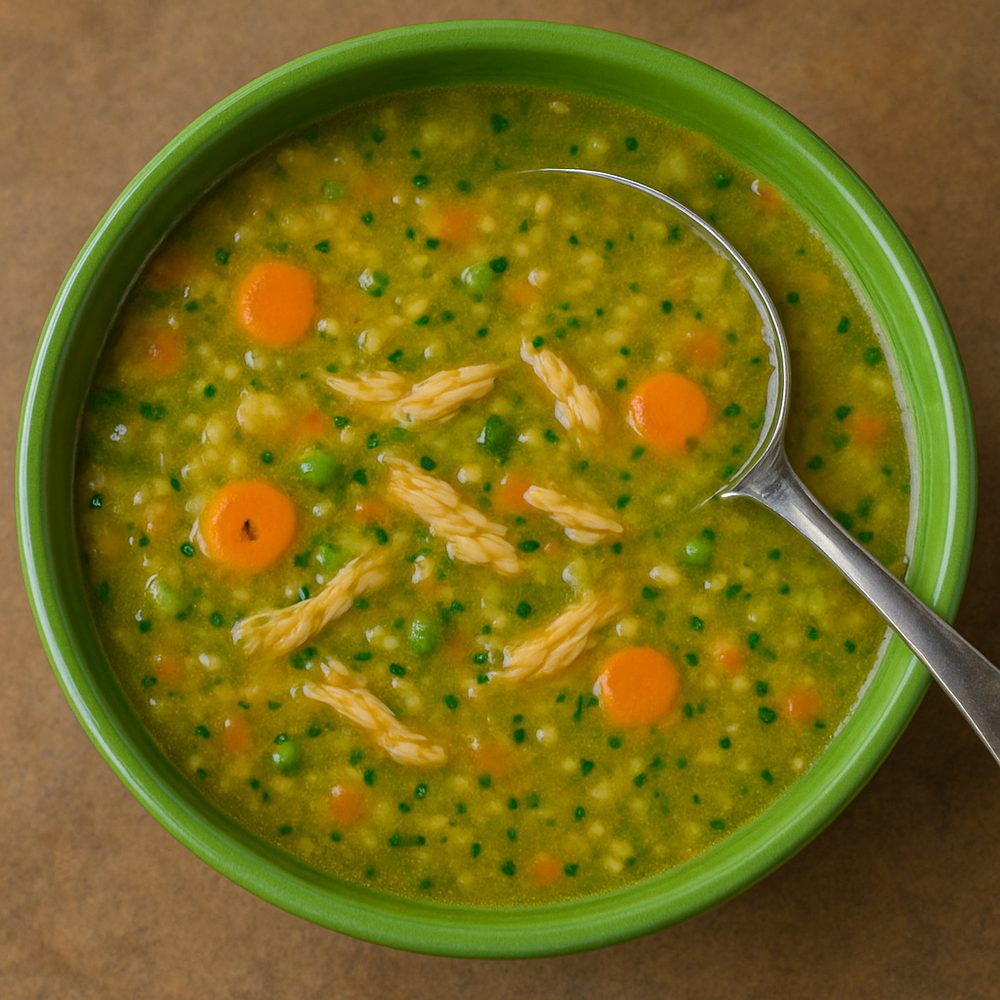



See the full menu or ask our nutritionist what suits your pet.
Was this helpful?
Share with a pet parent